Showing posts with label I Have To Live With This Guy. Show all posts

Monday, May 5, 2014

Memories of Dick Ayers

90 years is a good life. And so is being able to make a living at what you love to do for most of that life.

Dick Ayers, the artist most famous for his contributions to the Silver Age of Marvel Comics (inking Jack Kirby, and a 10-year run penciling Nick Fury), passed away yesterday. (Read more about his career here.)

We've lost not just a member of our community, and an important ambassador for the medium's history, but we also lost a gentleman and, more importantly, a husband and life partner to his lovely wife, Lindy.

Lindy is the source from which my personal association with Dick was fostered. My first book, I Have To Live With This Guy!, told the tales of the spouses/partners of comic-book greats and, given Dick's long and multifaceted career, I was ecstatic when Lindy and Dick agreed to be part of the process.


Thanks to my Secret History Of Marvel Comics co-author, Dr. Michael J. Vassallo, I had the pleasure of visiting the Ayers' home on two occasions in late 2001/2002. They lived near by Doc V. and the first visit (in Nov '01) was really a visit to Dick and his home studio...


One of the memories of this visit that is seared into my brain is something you don't see in this picture. Just before you walk into this room, on the wall to the left, is a letter from DC Comics to Dick. It was a formal acknowledgement of his role in the creation of the character, Scalphunter, who first appeared in the 1977 comic book, Weird Western Tales #39.

Thursday, August 16, 2012

Muriel Kubert on Joe Kubert P2

Yesterday, we published the first half of my 2002 interview with the late Muriel Kubert for my firsts book, "I Have To Live With This Guy!", on life with her husband, the recently departed Joe Kubert.

Below is part two, including the follow-up questions and my interview with Joe about Muriel and her contributions to the family, to his career, and to their school for cartoonists. God bless them both. Few leave such a legacy, few have such an impact on so many in the business.

Muriel Kubert interview
P2: Thursday, March 7, 2002

BB: What is the experience like, to be able to first open that thing (the Kubert School)?

MK: Exciting. It's still exciting. You look around and you look in the comic books. Sometimes I'll take a look in the Buyer’s Guide - very rarely - and I'll see the names of our kids. It's really something. And we have international students too. There's one boy, that I used to call my Nigerian son, he's now the top political cartoonist in England. It's wild. It really is.

BB: So that first 22, do you remember all 22 of them?

MK: I don't know about all 22 of them. There was Rick Veitch. There was Steve Bissette. There was John Totleben, or did he come a little bit later?

BB: They all still hang together, the three you just mentioned. They all hit Swamp Thing at one point or another. They all traded off from each other. Are those some of the guys that stand out?

MK: Tom Yeates. I’m trying to remember the names. It's going back, what, 26 years?

BB: Once the school is open, what are you doing the school?

MK: I was there all day. Early in the morning until school closed, I think we closed at 4:30. I love to cook, but at that period of our lives, we opened up a charge account at the diner because I didn’t have time to cook.

Wednesday, August 15, 2012

Muriel Kubert on Joe Kubert P1

Muriel Kubert passed away in 2008 after 57 years of marriage to her husband, Joe Kubert, who has now joined her in Heaven. I had the distinction pleasuring of having Muriel and Joe participate in my first book, "I Have To Live With This Guy!", back in 2002. She was a strong woman, knew her business, was protective of her family and their legacy (five children; two, Adam and Andy, important artists in their own right), and an integral part of the Kubert School that has produced many great cartoonists during its now 36+ years in business.

In my book, I combined the Kuberts in a chapter with Stan & Joanie Lee, as well as Will and Ann Eisner. All three were examples of men, and families, who broke the mold, in terms of finding success in the industry that was accomplished beyond the pen. All three men were good businessmen, and good salesmen.

Originally, my book was going to be nothing but interviews, but I wanted to provide more context, so I went the prose route. So, here, for the first time, is the entirety of the Muriel Kubert transcript (edited afterwards by her), in two parts. We'll publish part two tomorrow night, which includes the follow-up questions and my interview with Joe about his wife and her importance in his business and their family (read onwards after the jump break).

Muriel Kubert interview
by phone from New Jersey
for “I Have To Live With This Guy!”

Blake Bell: I'm speaking to Muriel Kubert on Thursday, March 7th, 2002. Muriel, I was wondering if you could tell me a little bit about your background; your family background; where you grew up.

Muriel Kubert: I grew up in New Jersey; a small town, Towaco, New Jersey.

BB: Now, when you say small, how small?

MK: At that time, maybe five thousand people. My dad had a small supermarket there – Fogelson’s Super Market. I went to Booton High. I went to Rider College after that. Got a B.S. in business administration.

Sunday, August 12, 2012

Joe Kubert: My Memories

Comic-book legend Joe Kubert has passed away at the age of 85. His first published work dates back to 1942 and he was going strong to this day. His catalog of work is extraordinary, as is the quality of the work from start to finish, a true rarity. He also left a huge legacy on three other fronts: he influenced a number of artists, including a young Steve Ditko back in the early 1950s (Ditko's earliest work in 1953-54 bares a remarkable resemblance to Kubert, not just in how Ditko drew his faces, but in how he laid out a page and how he set up a panel).

Kubert also influenced generations of artists through the Kubert school, and through his two sons, Andy and Adam, who have gone onto great heights in the industry as artists.

My association with Joe began in late 2001 when I convinced his lovely wife, the late Muriel Kubert, to participate in my first book, "I Have To Live With This Guy!" that was published by TwoMorrows in 2002. Muriel was a very strong woman, no-nonsense, and a strong force in the Kubert School.

To promote the book, I hosted a "Joe and Adam Kubert" Panel at a Toronto Comicon on August 24, 2002 (in the front row was Dave Sim, who disappeared with Joe after the panel to talk about the school, etc.). Here's a (long) transcript of the panel after the jump. God bless you, Joe, as you join Muriel in Heaven...

Tuesday, May 8, 2012

#31DaysOfDitko: Dave Sim reviews Ditko

Back in 2007, I restarted work on my Strange & Stranger: The World of Steve Ditko book and, upon learning that Dave Sim (creator of Cerebus and Glamourpuss) was an ardent admirer of Ditko, I sent Dave a whack of late 1950s/early 1960s Ditko material. I asked him to review it on my old Ditko Looked Up website, in exchange for links to his Cerebus trades. I thought I might get a page worth of words, generalities, but Dave sent back a lot of words, with a lot of specifics.

He also sent an introduction for his reviews that I share with you here too. Dave used to do a blog back then, so he posted the intro. there and then linked to my site for the reviews. Only Dave could write an intro. like this...

Saturday, April 28, 2012

Dick Ayers, 88 Years Young Today!

Famed Marvel Comics artist Dick Ayers is 88 years young today! Dick is primarily known for his work on the Sgt Fury strip for Marvel (Fury set to appear in the Avengers movie, played by Samuel L. Jackson), as well as the go-to inker for many 1960s Marvel books drawn by Jack Kirby and Steve Ditko. But he started in comics in the late 1940s before first reaching Marvel's doors in 1952. Below is a brief selection of his work, including one of the first pieces of work he did, the cover to "Jimmy Durante Comics" in 1948.

He also "inked" Ditko on the first issue of Iron Man that featured Ditko's seminal redesign of Kirby's clunky armor into the version that still lives on (also in the Avengers movie, Iron Man played by Robert Downey Jr.) almost 50 years later. I put "inked" in quotation marks because Ditko would do very sketchy pencils, adding most of the details when he inked his work. Problem is that Stan Lee started using Ditko like he had being using Jack Kirby - get a new feature going, ensuring the strip was drawn "the Marvel Way" before another penciller/inker would finish it off. As you can see on the original art to Iron Man #48, Ayers whited out the part that suggests he only inked the issue, so that it read "Art by Steve Ditko and Dick Ayers". The issue is also known for having been "watered down" in that the name of the villain was originally called "Mr. Pain" but was changed to the less frightening "Mr. Doll".

I was blessed enough to get to know Dick and his wife, Lindy, in 2001 and interviewed them for my first book, "I Have To Live With This Guy!" A few years later, when Dick was doing his auto-biography in graphic novel form, he drew me into his book (yes, I am that dashing)...


Read more on Dick's career here and here, and scroll through the vast collection of original art and covers on the Heritage Auctions website archives. Happy Birthday, Darlin' Dick Ayers!


1st Row: original art to Tales of Suspense #48 (Dec '63); published version of TOS #48; original art to pg 17 of TOS #48 (all pencils by Ditko, inked by Ayers)
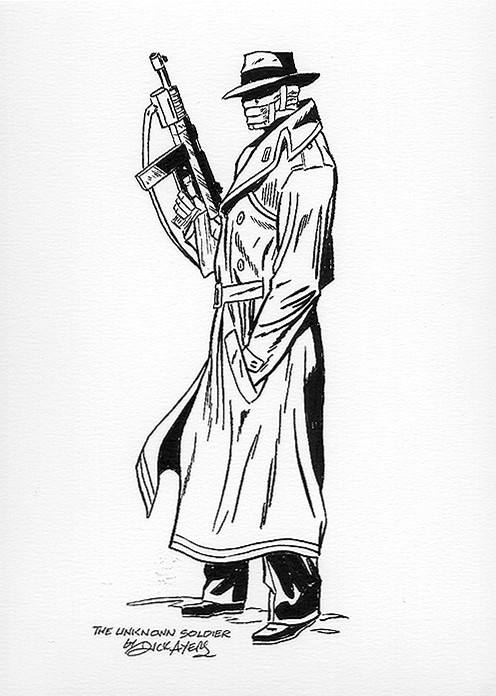
2nd Row: Jimmy Durante Comics #1 ('48); original art to Sgt. Fury #33 (Aug '66); pen & ink of "The Unknown Soldier, 2001 (owned by yours truly)

Sunday, March 18, 2012

My interview with Josie DeCarlo P3


We've come to the end of our celebration of the late Josie and Dan DeCarlo (and what a better way than with the above 1940s piece by Dan; an elaborately-drawn envelope for, no doubt, another love letter to Josie). She will live on in memories and in Dan's artwork, immortalized as the Josie in Dan's creation, "Josie & The Pussycats". Here's Part 1 and here's Part 2. Part 3 finished off the original interview, done for their chapter in my first book, I Have To Live With This Guy!, published by Twomorrows in August 2002, and adds the follow-up questions at the end. RIP Josie...

Josie DeCarlo P3
taped March 17th, 2002, by phone from New York for 
“I Have To Live With This Guy!”


BB: Stop me if I'm being insensitive here, but financially, with no pension from Archie, are doing okay? Are you and the grand kids doing okay?

Saturday, March 17, 2012

My interview with Josie DeCarlo P2


Yesterday, we posted Part 1 of my interview with the late Josie DeCarlo. Josie was the basis for her husband Dan's fictional comic-book rock band "Josie & The Pussycats". The above photo (click to enlarge) is Josie in full pussycats attire on a cruise with Dan. Below is P2 of three of the 18000+ words compiled for their chapter in my first book, I Have To Live With This Guy!, published by Twomorrows in August 2002. I haven't even looked over this, so I'll be reading it with you for the first time in about 10 years (part 3 tomorrow)...

Josie DeCarlo P2
taped March 17th, 2002, by phone from New York for 
“I Have To Live With This Guy!”

Blake Bell: Now when he was working at home, when the door was closed you wouldn't go anywhere near to his workplace?

Josie DeCarlo: It meant, “don't disturb” when his door was closed.

Thursday, March 15, 2012

My interview with Josie DeCarlo P1


I hate waking up to sad news. Saw a mention on Twitter yesterday and Mark Evanier confirmed it - Josie DeCarlo, the basis for her husband Dan's fictional comic-book rock band "Josie & The Pussycats", has gone to be with the Lord

My interaction with Josie was borne out of my desire to include her in my first book, I Have To Live With This Guy!, published by Twomorrows in August 2002.

I was interested in lining up a diverse list of spouses, from all eras and walks of life, and wanted to feature Dan and Josie mainly because Dan's work was outside the superhero genre. In fact, you could make the argument that Dan's work had been seen by more people than any artist connected to the book.

Dan, of course, was the star Archie Comics artist for decades until 2000 when he decided he deserved a cut of all the money Archie Comics was making off his work (a live-action movie of Josie & The Pussycats was released in 2001 - some projects deserve to fail miserably) and went to war with the corporation.

After coming up with the concept for my book at the 2001 San Diego Comicon, I was able to close the deal with Josie and Dan at a November 2001 convention in New York City. You may not have guessed it from looking at her skinny frame, but that was one strong woman, filled with French passion and conviction...and a strong determination to support and further her husband's career and legacy.

How strong was she? A month after we all met in NYC, Dan passed away far too early, the added stress of a long, draining legal fight not helping. I still remember mulling over that next call to Josie about her participation in the book. Was I being insensitive even suggesting we continue? But, as I said, this was one strong lady and, when we spoke, she absolutely insisted continuing, again focused on continuing her husband's legacy.

And this strong lady had stories to tell! Not just about Dan, or her and Dan, but about an amazing life lived prior to their meeting that no doubt built that strong foundation that Dan so relied on throughout his life and career. Josie came out to the San Diego Comicon in 2002 and was on my panel for the book (a couple of months before publication) with Ann Eisner, Deni Loubert, and Jackie Estrada and Josie stole the show with her harrowing tales of growing up and her fabulous love story with Dan.

(Here's a pic for the ages: Dan on the left, flanked by Jeff Smith of Bone fame, someone unknown over Josie, then Sergio Aragones and Will Eisner on your far right at the San Diego Comicon 2001. Click to enlarge.)


It's terribly sad to reflect on how many of these I am writing, having posted the Adrienne Colan chapter when she passed away last year. We've also lost Muriel Kubert in 2008, as well as husbands Will Eisner in 2005 and Ric Estrada in 2009. Praise God for those who remain in good health and we wish them long lives.

So let's celebrate Josie DeCarlo's life a little differently. Her story is so impressive, and I have 18000+ words (34 pages of single-space text!) from our conversations together, so I am going to publish the whole interview, versus the chapter in the book. Generally, I've preferred to go with a revised version of the chapter, because I added in a lot of context, but I so love Josie's story that we'll let her tell it, in three parts starting tonight. Lots of talk about Archie, of course, but also around Dan's time working with Stan Lee, and for Martin Goodman's Humorama magazine. Click on the "Read more" to view the entire text.  RIP Josie...

Josie DeCarlo 
taped March 17th, 2002, by phone from New York for 
“I Have To Live With This Guy!”

Blake Bell - I’m speaking to Josie DeCarlo on Sunday March 17th from her home. Josie, I was first interested in talking a little bit about your family background, where you grew up and what it was like to grow up in Belgium, if that’s exactly where you grew up?

Saturday, July 2, 2011

Gene and Adrienne Colan: A Love Story (P3)

 
Back in 2001, I sold TwoMorrows Publishing on the idea for a book that focused on the stories of comic-book history's greatest creators...seen through the eyes of their spouses/partners. It was my first-ever book, and I titled it "I Have To Live With This Guy!" I came up with the idea at the 2001 San Diego Comicon, after spending time at the show with couples like Gene and Adrienne Colan.

In memory of Gene passing Thursday, June 23, we're representing the first chapter of my book (slightly edited). Click HERE for part one and HERE for part two. Every quote is in Adrienne's voice. Onto part three...

"I Have To Live With This Guy!" (published Aug '02)

Chapter One - Gene and Adrienne Colan (Part Three)

As she had done for Gene at the Sherry Studios in the early ‘60s, she finally has to confront Gene to help him say stop. “It must have been within that week I came into his room one day and asked him, ‘Why are you continuing this way? Why aren’t you quitting? Is it because of me, the children, the whole suburban thing, the house, the cars and the stereos?’

“All these years he’s at his board, when the family comes in and talks to him, he would always not even stop work. But now, he stopped his art, turned around and said, ‘Yes.’”

Adrienne marched into her son’s room and typed her husband’s resignation. Stan Lee attempted to mediate by long distance, but he was already off to set up the Marvel Hollywood offices, and was no longer a buffer. Marvel asked Gene to stay to try a six-month trial period. Adrienne was hopeful, but not for long.

“The vice-president at the time, Mike Hobson said, ‘I’ll talk to Jim, see if the two of you can...’ blah blah blah. They got Jim to write this so-called apology letter. In fact, Virginia Romita called and she said, ‘Gene, hold on; you’re getting an apology letter.’

“But it wasn’t an apology letter - it was just whatever fantasy world he’s in. It was his version of an apology letter, but it wouldn’t have mattered because it wasn’t an apology that Gene wanted. He told Mike Hobson and he told Jim, “I only want one thing: I just want creative license. Just leave me alone. That’s all I want.”

Exactly what Jim Shooter thought he was going to accomplish, trying to alter the style of a thirty-year veteran was unclear, but he wouldn’t relent.

“Shooter said, ‘I can’t do that.’ Gene said ‘Well, I can’t work here and I don’t want any trial period’.”

In the summer of 1981, Gene took his last walk into the Marvel offices. “Jim stood there and stared out a window while Gene talked and tendered his resignation. Gene walked out of Marvel and people -- including John Romita -- came out of their doors with their thumbs up. It was like something out of a movie.”

Adrienne’s role in Gene’s life took a dramatic turn. They were now partners in the truest sense of the word. Gene handled himself where money was concerned in the pre-Shooter days, but the aftermath left him a man who cared to focus solely on the creative. “Once a year it was a little bit nerve-wracking having to ask Sol Brodsky for a raise and it was always like pulling teeth. Not because of Sol, but just because it was hard to get raises. You’d get fifty cents to a dollar. Outside of that, there was no politics.”

After the Shooter years, Adrienne not only continued handling the household finances, but she became his manager. She never went back to work after raising the children. “I really just worked for Gene to facilitate him being able to draw. I stepped in and did negotiating contracts for him. Post-Shooter I really had to because it makes Gene very nervous. When he has to talk business or numbers or contracts or dates, it’s like he may as well be back in third grade and the teacher may as well be teaching trigonometry!

“The only thing I really felt that I missed out on was those eighteen years not being in Manhattan. As far as a career, I was just thrilled to see Gene evolve, to see those original pages come to life and hear compliments from the editors and writers. It was gold to Gene and it was like platinum to me.”

After tendering Gene’s resignation, Marv Wolfman, who had been working on Gene for a year, had no problem coaxing Gene over to DC. “Before Gene took the resignation letter in, Gene called Marv and said, ‘Do you think there’s room for me at DC?’ Marv said, ‘Hang on, I’ll get right back to you.’ Within an hour, Marv called and said, ‘You’re hired and we’ll work on Night Force.’

“We knew when he handed in the resignation, he could literally just cross the street, but we had to forget that we lost a lot. We lost a lot of benefits, insurance, savings, he was working towards a pension - a savings plan where they added equal to it. We got that - what we had put in - but those kind of good times were over. At least he was able to continue to be gainfully employed and even go over there with a contract.”

The reality was that Gene had little choice if he was going to remain in the comic-book field. 1981 was not the time to be out of the mainstream loop with a mortgage and a family. He may have made even more money in advertising, but creatively that would have left himself a husk of the man he was at his peak.

But DC Comics had never been Gene’s home. Night Force was not a mainstream superhero book, neither was his project, Nathaniel Dusk, with writer Don McGregor. Gene’s contract with DC came to an end. They used him in whichever way they could – on Batman and Wonder Woman - but Gene was a ship lost at sea. By the summer of 1988, there was nowhere else to go.

“Then I really started actively helping Gene with his career, choosing projects, taking up teaching, selling original art, negotiating contracts.”

What was left for the couple was living on a project-to-project basis, jumping to and from smaller, independent companies like Eclipse and Comico - neither of which survived the 1980s. There was not even a guarantee that his work would be published at those places. Feelers always had to be out, in case the roof caved in on a job.

When Shooter left Marvel in 1989, Colan and McGregor were back at Marvel – “back” being the word, as Gene was restricted to anthologies and one-off jobs.

“Make no mistake. It has been nerve-wracking to keep his career afloat. A lot of manipulation, a lot of flexibility, a lot of keeping ourselves together emotionally - it could often be unpleasant. We had to give the impression of not being needy, of being busy and gainfully employed, like ‘What do you have in mind? I’m willing to listen. I’d love to hear the project.’

“This comes full circle. Remember that man I met in Tamiment that had no guile? Well, I had to go beyond being a secretary and sharpen my own street sense. I could pull it off better and he was grateful for some relief. Business can be tough, especially to sustain success without losing one’s principles, humanity and mind.”

With the children out of the house, they moved into a one-bedroom Manhattan apartment. “We had the whole bedroom set up like an art studio and had a fold out futon bed for sleeping. I had my own office - also in the bedroom - but Gene’s whole art studio, it was beautiful built-ins. It was just a great setup. In a sense it was a nerve-wracking time, but we were very close. The children were gone; we found ourselves arguing less, excited about living in New York for as much as he hates it. There’s always a movie being made outside our door. I’d go do some shopping and have to come flying back saying, ‘Gene! De Niro’s on 67th Street’!”

Gene Colan had a heart attack in 1989, and Adrienne’s sense of “legacy” became more acute.

“I’m not a teacher,” said Gene who bristled at Adrienne’s suggestion about the School Of Visual Arts, but Adrienne put together the outline for the course and the syllabus. “I said, ‘Just get yourself hired.’ I told him how to get himself hired. ‘Go in there to the president, don’t let it be about you. Ask how you can be of use, and that you have your own approach to teaching, and it’s a hands-on approach, and it’s one of positive reinforcement.

“It was not just strictly to have a financial base or some sort of an income, but also for the nobility of doing the right thing. He would be a gentle and good teacher. He just has a lot to offer as a human being and particularly for sensitive artists, being one himself.

“I told him how to do the interview. He literally rehearsed it again and again, to walk in to the president and give a mental image that you want to roll up your sleeves and get started.

“I waited outside in the lobby at SVA and he nailed it! They needed him to write up a thing for the catalog; they all think that Gene was able to do it, but no. That was my end and I just rose to that challenge. I don’t even know how. I don’t think my twelve months at secretarial school, when I was seventeen, prepared me for that. Maybe it’s genetics and my total belief in Gene’s excellence as an artist and as a man.”

Her father’s example had taught her well.

“We muddled through. There always seemed to be something. Marv was calling with a project from Dark Horse, Curse of Dracula, or Don was calling, or an editor would call from a particular company. There seemed to be a small network of professionals out there.”

The couple moved to Vermont in 1991. “He tried to commute once a week to the School of Visual Arts every Friday - and did it for a couple of years. I would take him to the Albany, N.Y. train station, which is an hour and-a-half ride, and then nearly three hours by train - this is one way - and then to do two back-to-back classes just to keep an income coming in.”

The 1990s brought the industry to its peak (the success of Image Comics and one million copies sold of the second X-Men title) and quickly back down to its lowest valley (Marvel’s bankruptcy and overall sales diving by almost seventy-five percent by decade’s end). Artists from Gene’s heyday, artists from the 1940s to the 1960s, were deposited on curb, and most vanished from sight.

Gene’s page count, which once stood at over 500 in the middle of the 1960s, was reduced to fifty-five in 1993. “We held it together.”

They essentially had to until 1997, when events began to unfold that resurrected the reputation, the career of, but most importantly the will to live for Gene Colan.

“It all started when Gene was invited to visit a comic book store, That’s Entertainment, in Worchester Massachusetts. You may as well have said the moon. I don’t know why, I just felt we should accept the invitation. I’ve been keenly aware of Gene’s age ever since he’s been in his mid-60s and since his heart attack in Manhattan, around 1989.

“With that in mind, I say to Gene, ‘Do it. I’ll get you there. We’ll find Worchester.’ ‘Oh, I’m not being paid...’ he crabbed. I say, ‘Do it - Do the right thing. Whatever fans come, if they want a little sketch...’

“‘Well, I’m gonna charge,’ he threatened. I say, ‘No, you’re not.’

“‘Well, I wanna get paid,’ he grumbled. I say, ‘Maybe take five dollars. Make it a day where you’re not going to think about you. You’re going to think about giving, not receiving, and that’s the attitude we’re going to go with, all right?’

“The store manager, Ken, showed us the setup. He was working on a computer and I said, ‘Oh, I’m so afraid of them!’ “I did a couple of little things and he saw that I basically already understood the concept of it. He said, ‘If you ever want to learn about the computer, or setting up a web site, Kevin Hall’s the guy for you,’ and he introduced us.

“The book signing went great. We were supposed to be there two hours, but we stayed maybe four or five. There was a little electrical light out when we opened the car door to leave. To Gene, all things have the same value. In other words, cancer diagnosis or the light is out on the door: same hysteria!”

“There was Kevin. He was outside talking with a buddy when we discovered this pathetic little light that was out. Whatever it was, he just took care of it. He allayed Gene’s fears that nothing tragic was going to happen to us on the way home.”

Several months later, Adrienne got up the nerve to buy a computer and re-connected with Kevin. “I said, ‘Let’s work on a web site and eBay.’ That was it – the beginning of great career independence for Gene and deep connections to his fans worldwide.”

Kevin set up an official e-mail list for Gene. “That’s when Gene really came to understand just what’s out there. There are all these young men who grew up on his comics, who have grown into men of accomplishment, who could understand Gene’s artwork indicated a maturity and depth. The one thing Gene did understand, when he was working in the 1960s, was it was probably not going to be understood by most six-to-nine-year olds. Stan always told Gene, ‘That is your audience, Gene – six year-olds.’

“Gene understood that but couldn’t help himself. He couldn’t play down to that because he needed to stretch as an artist. We knew other artists were more popular because they appealed more to the masses, like Romita, and Kirby, and even John - because as powerful as their work was, it was clear. We knew his work was not always clear, not always easy for anyone, let alone a youngster to read.”

Adrienne was correct in her assessment that Gene’s artwork had many levels; levels a child could grasp, but deeper levels an adult could appreciate. Jim Shooter’s platform was to knock out all the levels he could, believing only then would Gene appeal to a mass audience.

“And that’s why Gene’s main criteria – his main criteria – is artistic freedom. Every project, that’s the only thing he wants and literally insists upon.

“In terms of managing his career, I said to him, ‘From this point on, we’re not going to accept just anything.’ You always want to be paid as well as you possibly can, but I said, ‘Different companies are going to have different budgets. We’re going to base the decision on how interesting is the project; how much do you want to do it; and if you want to do it, but the pay is lousy, do it. We’ll go for the exposure on that one.’

“It would be hard for most men to give themselves permission to prioritize the project, not the pay. I’m kind of proud of some of my thoughts are a little outside the box.”

Whether it was invites to conventions, the rebirth of the fanzine (in actuality, the prozine), or just fandom’s realization that, in ten years, everyone of their heroes would be long gone, the Internet helped lead a mini-revival of the Silver Age and Golden Age artists. This revival also helped to build interpersonal connections between artists who never before socialized, never before traded stories, together.

“Gene didn’t understand in those years how much was available to him in terms of friendships. For example, he would put John Buscema on such a pedestal; he was intimidated to call him. He’d want to call and reach out. One second he’d be all humble and intimidated, and then he’d get his back arched and say, ‘Well, I mean, he never calls me.’

“That would be his way of saying to me, ‘I feel like a baby - an idiot - calling him.’ Same thing with Tom Palmer; he would say, ‘He doesn’t call me to socialize; I feel like a jerk calling him.’ He wasn’t a card player so he wasn’t ‘one of the guys.’ There were times where Marv or Ernie Colon, or a whole group of them, would get together and play poker or whatever. Gene was not asked. He comes off somewhat aloof. He’s painfully shy around people. He really doesn’t know what to say.

Gene’s dream of reaching out to those fans has not altered from the 1950s until today. At the 2001 San Diego Comic Convention, a black man in his thirties – during the panel on Gene’s artwork – asked Gene about how he knew so much about black people. At the end of Gene’s explanation, the fan shouted out, “Black people love you, man!”

“That was just so extraordinary. It was like this great reward at the end of it all to discover that whatever he’s been doing in his art, and in portraying black people, that they know. It’s got soul; all his faces have soul.

“When Gene draws a black person, there’s a love for their look and their character that Gene feels. They are not caricatured. He would rather draw a black face, man or woman. It’s like the soul is deeper. They’re just more interesting to him.

“I think it’s his artist’s eye. It’s his good experience in the Air Force with black servicemen, as opposed to white servicemen from the South that were jerks. The nature of the black servicemen was, no matter how hard or how frightening the circumstances might be, they always found a reason to laugh and blow it off. It was comforting to Gene and he admired it. We have some fine art paintings of black people sitting on their porch he did in the days where he lived in a home in New Rochelle and there was a black community there. Times were different, and they didn’t necessarily really welcome him, but he got away with taking some photos.”

One watches Adrienne buzz around a convention table and knows she shares the same experience with a Carrie Nodell or Lindy Ayers. They are the caretakers, the “managers of the shop,” leaving their husband’s free to perform. “I know Virginia Romita’s a devoted wife, and she was terrific for John in that she knew how to be a company woman. I never met John Buscema’s wife until last year in San Diego: a doll.

“The only other wife I’ve ever met is Marsha McGregor, Don’s wife. I see some of myself in her. She does get in there to help Don storm through the life of a freelance creator. She’s deeply devoted to him, but she’s also worked all those years outside the home. She involved in acting and has her own life.”

The process of daily living for Gene, now in his mid seventies, is an exact one. “If I get up early, he gets up early. He doesn’t get right to work. He’ll walk the dog, maybe go to the post office in town, but he’s always been one who can’t gather himself quickly. He needs to get dressed, shaved, and have breakfast. Just that stuff takes like an hour and a half.

“I’m different – everything is bing, bang, boom. Everything – even the shower – is within a half-hour. Maybe that’s why New York and I fit. I’m just more of an ‘ants in your pants’ kind of person.

“He’d rather do a commission, no matter the size. At this time in his life, he likes tackling one main pin-up project than to tug along with a story – particularly one that doesn’t interest him. He almost doesn’t have that in him anymore. The only recent story he’s done that he just loved doing, and because of it the time went quickly, was Buffy the Vampire Slayer. He’s enjoying Doug Petrie’s scripts and is currently doing his second Buffy book, then onto a project for Argosy Publications.

With multiple prozines flooding the market, with conventions and the focus companies put on reprinting of various works - the Marvel Essentials and DC Masterworks - the impression one receives is that artists from the 1950s and 1960s may have suffered in the early 1990s, but now they’re doing much better now. This is not the case.

As spiritually healing as the past four years has been, the financial recovery has not matched. “Definitely not. It’s just the opposite. The cost of living is tough these days.”

Commissions don’t role in every day for the Colans, and Marvel’s latest editor-in-chief, Joe Quesada, flat out says he can’t market older artists. “He will command and get paid more per page,” she says. “Dark Horse is pretty generous, but usually because they’re studio-backed projects so the money is available.

“Marvel and DC – he will not accept any work from either. The projects offered so far are insignificant and the page rate is insulting. The projects are insulting. He doesn’t want to go out doing filler stuff.”

Adrienne is focused on her husband’s legacy and is willing to gamble that work will always be present, while the worry may be that she’s pricing her husband out of the market.

“Here’s an example of how ridiculous and hard-nosed Marvel is. They called him just recently for a pinup they wanted to use somewhere. He asked for $400 – which is like nothing. It was an elaborate superhero pinup. They said their budget was for something like $340 or $350. Would you believe they let him walk?”

Is love blind? Few love as hard as Adrienne Colan, and few respect their husband’s talent more. “He’s not going to lend his great talent, his great name – this is me, he will never say something like this – and he will just feel bad and feel demoralized, but I put the words to it to get his ego back up.

“The conversation around here goes like, ‘No, you’re not going to take it. I’m not going to have you lend your talent and your name to something like that and they can’t even pay you a pathetic little amount. Your fans will pay you better than them. They’re riding on your great name and they can’t even, for like $50, stretch it? He is a marquee name for them and if they have a budget of $350, and they can’t even pay him $400 for a pinup that they’re going to make a fortune on? No.

“When you think of how much they have given other artists who are ‘hot tickets’ - taking nothing away from them; great for Todd McFarlane, he’s a great businessman – we know they play a game with the numbers. So, I give him the words so he doesn’t stay in the demoralized state, but feels proud of himself.”

But Gene is not on the Top Ten list of favourite artists in Wizard Magazine (the Teen Beat of the industry), and Marvel won’t even make a fortune on the Spider-Man movie. Adrienne walks a tight rope between reality and keeping her husband’s confidence high.

But Gene’s talents haven’t abated one bit. Few in the industry from his era are still drawing. John Severin, Russ Heath and Colan (when dedicating themselves completely to a project) are the three most able to lay claim to the fact the quality of their artwork has not diminished with age.

So deep was Gene’s desire to return to the fold, so deep were the scars from his break with Marvel that, in early 1997, when he receives a call from Ralph Macchio to go back to Daredevil, Gene confessed to Adrienne he had been waiting for the call for years.

“He never told me this. I said, ‘You’re kidding me.’ He had a secret desire and believe me, he tells me everything. We’re together all day long. Every thought in his head comes out.”

The dream only lasted a mere handful of issues before conflicts with the series writer, Joe Casey, had Gene withdrawing from the project. Unless Gene is comfortable with a writer, unless Gene can be given what he considers enough artistic license, he will not devote himself to a regular book.

“As far as his emotional state, his mental outlook, and just his whole sense of how he feels about life, he’s just never been happier. He would never be able to accept a monthly comic now, but it’s the best time of his life. The money isn’t the be all and end all. There’s no sadness here, no bitterness because it’s been a great career and a great life. He’s a very happy man.

“We love one another and have been very fortunate in the past several years, living up here in Vermont, to have made some extraordinary friends. A couple of them are artists – not comic book artists - and that’s of great satisfaction to him.

“He’s still collecting photo reference. There is still art on his desk everyday to be drawn.”
Extraordinary talent doesn’t make a career. If you don’t own the company, or own your own creations, you can be crawling your way in the dark, hoping the sharp edge to your left is not a cliff over which you are about to spiral off.

“She has been my biggest fan and most severe critic,” says Gene, “hardly ever wrong in evaluating where I went wrong on any of my work. She has been the driving engine in my life that has never quit. I have seen people stop her in the street and ask her for directions on how to get to a place and she never fails to know how. She will always be my North Star.”

Marriage can be like crawling around in the dark. You reach out your hand and realize you’d rather not be in the dark with anyone but this person who truly loves and respects you, your work, and your desire to remain in an industry that brings your life as many cliffhangers as you have drawn on the last pages of so many stories.

Wednesday, June 29, 2011

Gene and Adrienne Colan: A Love Story (P2)

 
Back in 2001, I sold TwoMorrows Publishing on the idea for a book that focused on the stories of comic-book history's greatest creators...seen through the eyes of their spouses/partners. It was my first-ever book, and I titled it "I Have To Live With This Guy!" I came up with the idea at the 2001 San Diego Comicon, after spending time at the show with couples like Gene and Adrienne Colan.

In memory of Gene passing last Thursday, we're representing the first chapter of my book (slightly edited). Click HERE to read part one of our three-part series. Every quote is in Adrienne's voice. Onto part two...

"I Have To Live With This Guy!" (published Aug '02)

Chapter One - Gene and Adrienne Colan (Part Two)

In the early-to-mid 1960s, Stan Lee was not above using the “Why, you’ll be working for Marvel!” line when trying to hook back artists he desperately needed (knowing he could count on them to consistently produce product). Stan also called John Romita, offering far less than DC. Lee would feign indignation at their refusal, but he would always call back the next day with a five-dollar page rate increase that cinched the deal.

Gene Colan had a quiet pride about him, and didn’t leap at Stan’s bait. “Stan got a little huffy and said, ‘Look, forget about it. I don't need this. Quite frankly, we’re getting a lot of artists from Spain and can pay them way less than you and they're sensational. We are not going to need you anyway.’

“Gene said, ‘Alright, Stan,’ and ended it cordially. The phone rang the next morning. We were thrilled. $5 a page was money for us at the time! Marvel was truly where Gene wanted to be working, but he just felt it wasn't right for Stan to ask him to be exclusively Marvel, offering nothing other than being exclusively theirs. Gene and Stan have never been able to be cross with one another for more than a minute.”

The dream had been achieved. By the summer of 1966, Gene began his nine-year run on the Lee / Bill Everett creation, Daredevil. The work was steady enough for Gene and Adrienne to eventually move into their own home. There would be twelve years of creative harmony before the walls came crumbling down in the worst way imaginable.

The greatest myth of Marvel Comics in the 1960s: an actual bullpen, a gang of raucous comrades, whooping it up all day in the tiny offices at 625 Madison Street. Such is the charm of Marvel Comics during the “Silver Age of Comics.” Stan Lee’s hyperbole made you want to believe it all. In fact, Gene had worked at the only true Bullpen Marvel ever had – in the Empire State Building of the late 1940s.

Like ninety percent of all people who came through Marvel, they worked at home, or in their own studios. In his earliest days at Marvel, Gene, Adrienne and baby lived in their Queens apartment; one room devoted to the baby's nursery, a living room/dining room combination, a tiny little kitchen, and their bedroom.

In these cramped quarters, a freelance artist must be able to exist in harmony with his environment. Distractions are the work-for-hire’s worst enemy, but the toll is not the artist’s to absorb alone. “Gene had a corner of our bedroom. He’d get to work around 10am, but then days would end like 12am, 1am, 2am and very often not. I would go to sleep with the light on. He put in so many hours to do as much work, and be as perfect, as he could.”

With Gene trapped indoors by his career, the age difference finally became a factor, manifesting itself in the cultural divide between the woman in her early twenties and the man closing in on forty. “I would say in my twenty-year-old enthusiasm, ‘Want to go to Woodstock?’ Like who wouldn't? How can you not be part of it? He would, in his 36-year-old voice, ‘What? Are you nuts?’ There was some stress in that regard.

“He also came from an era of showing a lot of attention and respect to parents. In 1963, I'm still twenty years old. I grew up with East of Eden, Rebel Without a Cause and Splendor in the Grass with Natalie Wood and Warren Beatty. He looks back now and thinks I had every right to expect to see concerts more and parents less... and he adores the Woodstock album!”

The lack of time spent together due to work took the greatest toll. “It wasn't too bad in Queens because he could work up to nearly the last minute, and a restaurant and a movie were nothing more than a walk or five minute drive away. When we moved out in '66 to the suburbs - which was Gene's heart's desire - my feelings hadn’t changed. I wanted to stay in the city. That was the lifestyle I liked.

“I said, ‘When did you know you hated the city,’ and he said, ‘When I was six!’ He always felt that it was crowded, doesn't like the pace, found people intolerant and had some really bad experiences. He’s been held up at knife point. He's been chased after with knives. He's had to stand up to bullies and get beaten around, but won the respect of the bully because he stood up to him. It may have been awkwardly, but he attempted to beat the crap out of the bully, so I guess the bully gave him an ‘A’ for effort.

“I, myself, have been pick-pocketed twice, maybe three times in Manhattan and I see no dark side. I just feel alive. I think if he never saw the city again, it would be too soon. He tells me now that he enjoys the city going back more as a tourist, but I don’t believe him.”

The dichotomy was that Gene’s work for Marvel had such an urban, downtown Manhattan feel to it. “In spite of himself, what is more interesting to draw? What's more edgy than a street scene, interesting architecture, garbage cans, and chain link fences?”

Ripping and snapping became Gene’s tools of trade out in the ‘Burbs. “He worked from reference he had already been collecting since 1946. He kept it current with taking pictures of street scenes. Even when we lived in Queens, even when we moved out to New Jersey, and even living here in Vermont, when he wants a particular scene, we simply go into the city with his camera. Most of his reference material is his own angles and perspective, but Gene has an extensive file of pictures of everything from every imaginable source. I usually say, ‘No magazine or book is safe around him!’

“When we got to the suburbs in 1966, and for all the eighteen years we stayed there, those were very tough years, in terms of the hours he put in. He would come out of his room for maybe lunch and definitely dinner, which we'd have with the children, then right back up to the art board. He'd come down for certain things. We'd all say, ‘Daddy, come down the Waltons. Let's go!’

“Outside of that he was really in his room. That was very hard on me because I didn't fit into the suburbs at all. Even though I had friends, I felt very lonely.”

Luckily for Gene, he was an artist who preferred background noise when he drew. In the days of their Queens apartment, daughter Nancy “wasn’t more than 6 footsteps away. Day or night, raising her never interrupted with his work.”

Their son Eric spent a great deal of time looking over his father’s shoulder. Such is the trade off of having your father around twenty four hours a day, just within reach, but forced to be a million miles away in the fantasy world he’s creating to make sure the roof stays over their heads.

“On one hand, it was all right for the children but, looking back on it, it wouldn’t be what a modern father would consider proper raising of a child at all. He didn’t like sports, so he wouldn’t be taking Eric to any kind of games. On the other hand, Eric was a born artist; he didn’t feel he missed anything. When I’d leave to shop or run an errand, he’d sneak in and show the kids scary movies. I wanted to kill him!”

Perhaps it was the insane assortment of sounds emanating from Gene’s in-home studio that produced such a unique style. “We’d get calls from friends, saying, ‘Turn down the volume!’ It could just blow your eardrums out.”

Gene’s ambient music consisted of classical and modern classical music and...sound effects? “In those days, he was big on reel-to-reel or eight track. He would record dialogue from the audio of films and would play back entire films for himself while drawing, driving me nuts.

“It was horrible, because most of the time he was not playing the kind of music I wanted and, even if he did, it was just unbearably loud. He would just be in his own world.

There’s no escaping the stress of trying to raise children, who are on their own body clock, while a freelancer burns the midnight oil. “I’d be in the bedroom trying to sleep, but not really. The light would be burning in the next room and I would have to say, ‘Will you come to bed already?’”

Working continued even outside the home. “We would see parents on the weekend, mostly mine, therefore, we could count on one day of the weekend where he would not be working. When they’d leave, though, he’d go back to work. My Dad rigged him up an art table in their basement so Gene could work while visiting in Fairlawn if it was a real tight deadline.”

Two factors played into Gene’s decision to never say never to Stan Lee’s constant supply of stories - money and ego. “There was a fear, definitely about money, but Gene loved being put on all these titles at Marvel. He loved the opportunity to show what he could do.

“It was also about ego. If he has a shot to do X, Y, and Z characters all in one month, he wants to be the one to do it. When he was a kid, he wanted to be a famous artist. I think that’s dear and sweet and it charmed me.”

As with most artists from the 1950s and 1960s, Gene was completely oblivious to any sense of fandom. To whom was Gene showing off? “His editor, himself, and the fans that he imagined were reading. He didn’t think of them so much as fans, but readers - readers of comics. He hoped they noticed he was trying to make it feel more like a movie, more like going on a trip, where you’re suddenly not aware of anything else but the reality of what’s on the pages/screen. Artistically, that really turned him on very big.”

There are traps involved in the artistic process, and many not of the creative variety. Gene took on the artistic reins of Dr. Strange and the door to a bottomless pit opened. Gene almost fell in. “He began to take amphetamines to keep pace. Eventually, I demanded he stop those pills. I feared he’d bring on a heart attack. He then discovered cough syrup with codeine, but eventually stopped all those things.”

Letters to the editor were the only connection a creator may have had to the readership. Stan Lee turned the letters’ pages into raucous events, but it wasn’t until comic book conventions began in New York that artists like Gene felt the impact of their work. Adrienne and Gene attended one of the first conventions ever, across from Madison Square Garden in the late 1960s.

“Whoever was running this convention secured a balcony level of this hotel with tables going around the balcony area. We didn’t know what to expect. We walked into the lobby and he was besieged by a bunch of fans asking for sketches. Before he could even get upstairs to his table, he was in the lobby drawing sketches and signing autographs. It was so flattering. We were both dumbstruck!

“That was the first awareness that ‘Wow! There’s something going on here! There are specific fans that know specific artists and Gosh, you’ve got a bit of a name!’ We couldn’t wipe the smile off our face the whole train trip back to New Jersey. It began to snow and Gene and I thought this was the most romantic night of our lives – like a movie.”

For a proud man like Gene, who had seen the bottom, this adulation only egged him onward. For Gene it also helped cement his bond with Stan Lee. “They were gentlemen of a certain era, cordial, sweet by nature, ‘except if you talk about money!’ Gene would always say.”

From a working perspective, Stan allowed Gene the freedom to be the storyteller. “Stan would just call and give a five-minute synopsis of a seventeen-page story and it just didn’t get better for Gene. Even when he would do wrong on a rare occasion, he would get a call from Stan saying, ‘Enough with the car chases, Gene!’”

Gene became infamous for cinematically shooting scenes at different angles, and didn’t hesitate to draw out a scene for full emotional, or physical, impact. “What Stan would say was ‘The pacing! Why do you use the whole page for Tony Stark putting on his tie? And a whole page with the hand on the doorknob!’”

Lee knew how to handle each artist’s unique ego – especially the fragile ones. “Even in those days, the complaints weren’t intimidating. It was almost like a loving, ‘I know I’ve got a mad, little genius scientist here. I’m not going to harm you, hurt you, or make you correct or change.’ It was almost like begging, like, ‘Please, watch the pacing’!”

The early 1970s saw the Comics Code Authority relax its rules on the inclusion of all things ‘horrific,’ including vampires. Gene commenced work on what many consider his signature series, Tomb Of Dracula. It was a difficult series to write because the central character is a force of evil. Written by Marv Wolfman, the series spawned the vampire hunter, Blade, now with two Hollywood movies under his belt. Wolfman continued the Gene-happy trend of simply telling a story, rather than an overly wordy script with text panel-by-panel breakdowns.

“Marv was deeply respectful and appreciative that Gene would monkey with the script in order to allow Gene to display the visual the way he interpreted it. If Gene felt combining or cutting a page off in half in order to make that page become a cliffhanger - so you’d want to turn to that next page - he would pace it himself. In all those years, Marv never said ‘boo.’”

Scripts entered the household, but Adrienne believed imposing her point of view on Gene in this way was akin to his days at the Paul Sherry studio. “I have never seen or read one script in all the years – not from the very first day at that hotel - Gene has received from anyone. I’ve never heard the taped synopses Stan would give him. I was only aware of the duration of the phone call because very often I’d be sitting there in his room. If they ran ten minutes, that was a long conversation; five minutes would probably be more accurate. I have never given any direction or my point of view. My eyeballs should fall out, and my children’s eyeballs should fall out, if anybody thinks I am lying or even bending the truth!”

Two exceptions to this rule developed. “When Gene was working on Howard the Duck with Steve Gerber, I’d hear him in his room, day and night, roaring with laughter. He’d say, ‘You have got to read this!’ He’s just had the greatest admiration for Gerber. I’ve never known Gene to relish working on anything as much.

“The other was D.C.’s Jemm, Son of Saturn. ‘This Greg Potter, he’s terrific,’ and he would always ask me to read the opening. Each story would start out with a special preface that would be in a box or a scroll in the first panel. It was always very thought provoking and would set the tone for the story.

“I would see the pages as published comics for the simple reason that all those years that Marvel was sending him the monthly or bimonthly subscriptions, I would always shout out, ‘The package is here!’ It was the manila envelope with the rubber band around it.”

Further validation came from opening up those envelopes, with Adrienne boosting Gene’s self-confidence by pouring over his finished books. “I would always play this game - especially in these past years where he’ll get just a small story fit in with other people’s work - where I’d always go, ‘Now there’s this, and this, and this. Oh, and then there’s this.’“

The “this” was Gene’s work. “I’d line them up and it would make him smile – very quiet, very humble, but he’d smile. My point was you’d go, ‘Oh, this story, this story...what’s this?’ Even if you thought, ‘This is the worst thing I’ve ever seen,’ his would be the one that would make you stop.”

Gene appreciated two artists more than any others and the incoming package of books provided a monthly ritual for husband and wife. “He ran for two comics - Buscema’s and his own. There would be a silence that would fall over us looking at Buscema’s. Gene feels John Romita is brilliant - the quintessential American artist.

“Gene would check out maybe Joe Kubert or Gil Kane, but it was John’s work he had to see before even his own. It was John’s that took his breath away and by whom he measured himself. Other than the ones mentioned, there would be like a relieved ‘snicker’ on my part that Gene’s was superior.”

Even if they didn’t read it, Gene was so obsessed with having the reader always being able to follow the story from the art. Adrienne herself rarely read the actual stories. “Gene always wanted to keep the suspense alive for himself, so whether it was Marv’s or Steve Gerber’s or Greg Potter, he did not read ahead with scripts he would get. Of course, if it was just Stan’s synopsis, there was nothing to read.”

Within Gene’s work, she recognized photos she had taken for him, or ones he had taken of the children and her. “He would use Playboy a lot for Clea or the Black Widow. He always needed somebody with a raincoat on, or a broad-brimmed turned down hat and a gun or a rifle! We have more photos of Erik in some sort of ridiculous falling type of position in his underpants, so Gene could get the body structure. Our daughter despised it, but she would be a woman or a man in a particular position from a particular angle and light source. We have the most bizarre collection of family pictures!”

Gene refrained from using popular models or actresses of the day. “He is a notorious beauty parlor magazine swiper. He has files that are very specific: women looking right, women looking three quarters to the left, women looking up, women screaming. There’s like ten different categories. Doctors throughout the world are missing magazines that are all in my home!”

Gene continued his dream ride, a dream in the sense of working without interference for a company he loved. Perhaps he could have made more in another field, but he could never been anything but an artist. The consistent work gave him a sense of security, financially, emotionally and creatively, but it was all about to be ripped out from under him by one man.

The Devil in Disguise, as the song says, is Jim Shooter.

Martin Goodman owned Marvel Comics since the 1930s, but if you asked half the kids in America, Stan Lee ran the show. As long as it was the Goodman’s family business, Stan stood as a buffer between the business realities and creative needs of his artists.

After Goodman sold out in 1968 to the conglomerate Cadence Industries, the buffer began to weaken. Stan himself stepped down in September of 1972, leading to a parade of writers thrust into a position that forced them away from the creative side of the business. None of Roy Thomas, Len Wein, Marv Wolfman, Gerry Conway, or Archie Goodwin lasted more than three years each - Conway for only a month. Goodwin, considered by all to be the consummate editor, returned the company to profitability. He was keenly aware that proper people management gets the most of out of individuals with varied egos and unique personalities.

Goodwin resigned in late 1977, and left the door open for one of the most contentious men to ever walk through the doors of a comic-book company. On the first day of 1978, Jim Shooter became the editor-in-chief and lasted ten years in the position before being ousted by the corporation and burned in effigy by its creators.

Born in 1951, Shooter was a comic book prodigy, selling three Superboy stories to DC Comics at the age of fourteen. Shooter appeared at Marvel as an associate editor in 1976, also writing for The Avengers, Ghost Rider and Daredevil. Once assigned the role of leading the company, Shooter distinguished himself from his predecessors by jumping into the financial end with great vigor. All too appropriate for the 1980s’ definition of corporate mogul, Shooter soon simply wanted it done his way or the highway.

Argue over whether events like the birth of the direct market bolstered Marvel’s fortunes in the late 1970s, or whether it is solely Jim Shooter’s direction - everyone else does. He came in a blaze of glory, and left the same way. The only given was that, in every subsequent interview Shooter gave, the turmoil with the creative staff at Marvel during his tenure was never his fault. Shooter always had his loyalists, but the cause of every failing he recites lands in someone else’s lap, usually in the hands of those pesky creators who couldn’t take his directions.

There may never be a story more symbolic of creator versus businessman in the comic book industry than the story of Gene Colan and Jim Shooter. Gene’s fall from the high towers of Marvel, a fall from which he never truly recovered, in terms of consistent employment, underscores the thin line of the tightrope every work-for-hire artist in this industry walks on a job to job basis.

It became quite clear, quite quickly to Adrienne and Gene that Shooter either hated Gene’s style, or believed him to be incompetent as an artist. To this day, the bile Adrienne exhibits when mentioning Shooter’s name is very vivid.

One can argue the intent of Shooter, whether it was personal against Gene, or simply a professional man guiding his company’s ship in the necessary direction, but one can’t argue that Jim Shooter almost broke Gene Colan financially, emotionally, spiritually, and artistically. Financially, Shooter most certainly turned the Good Ship Colan into the Titanic, but of immediate concern to Adrienne was Gene the man.

A post-Gerber, Howard the Duck story was burned into Adrienne’s memory, but that was only the beginning. “The corrections were just so unbelievable. It was the amount of the corrections and the nature of what Shooter would ask.

“In all the years I had been married to him, I never ever heard him ask me anything about a script or what should be drawn. There we were, in a Chinese restaurant in Red Bank, and he’s asking me about a panel. He’s saying, ‘This is what I drew but this is what’s being asked of me. I just can’t see it because if I did, then the person who’s supposed to be flying on the top of the room would be on the bottom of the room.’”

Across the table, Adrienne’s watched her husband return, spiritually, emotionally, to the Paul Sherry Studio. “That was exactly what was going on. I was literally watching him just emotionally crumble in front of my face. It was a horrible thing to watch. He didn’t want the corrections, but he didn’t want to lose his job. Those were years where you got better contracts if you were in good favor. Those were years where Marvel was giving you vested interest.”

Then. Jim Shooter fired Gene Colan.

Stan Lee temporarily smoothed over a return, warning Gene about the cliff on which he’s standing. Gene returned, but the corrections kept coming.

To be attacked on a creative level was one concern, but Gene had a two-child family for which he had to provide. It was pulling the proud man apart. “I didn’t even realize all of that stuff was factoring in for him, in terms of why he was allowing himself to be tormented this way. He couldn’t even understand what was being asked - notes saying ‘your artwork defies the laws of gravity’ and things that would undermine his confidence.”

(to be concluded tomorrow night in Part Three...)

Tuesday, June 28, 2011

Gene and Adrienne Colan: A Love Story (P1)


Back in 2001, I sold TwoMorrows Publishing on the idea for a book that focused on the stories of comic-book history's greatest creators...seen through the eyes of their spouses/partners. It was my first-ever book, and I titled it "I Have To Live With This Guy!" I came up with the idea at the 2001 San Diego Comicon, after spending time at the show with couples like Gene and Adrienne Colan.

These artists worked mostly in isolation, so when they came together, the stories got bigger every year. I watched as the women stood patiently by their men, sometimes rolling their eyes, and you could tell these were the people who really knew the story behind these creators.

Adrienne Colan's passion for her husband, his career, and her part in both, changed the direction of the book and I moved their chapter right to the beginning because their story was just that good, just so "comics", in terms of its intensity and ups/downs that faced artists in the industry's infancy.

In memory of Gene Colan's passing last Thursday, we've been publishing a number of blog entries on Gene (this one will give you some good context on my relationship with Gene and Adrienne) and we're going to spend the next three nights representing the Gene and Adrienne Colan chapter of my book (slightly revised). Except for where Gene speaks in one paragraph, it's Adrienne's voice throughout. It's quite the love story, so I hope you enjoy it:

"I Have To Live With This Guy!" (published Aug '02)
Chapter One - Gene and Adrienne Colan (Part One)

“If anybody could draw a hand on a doorknob and keep your interest, it would be Gene.”

The above has been "rubber chicken dinner" line from Stan Lee, famed former editor-in-chief at Marvel Comics for almost forty years, but truer words...

Few artists in the comic-book field had a style as unique as Gene Colan. Stan Lee encouraged every artist during the 1960s who came through Marvel’s front doors to draw like Jack Kirby…except for two – Steve Ditko and Gene Colan. They arrived at Lee’s door fully formed, and suggesting alterations of their fundamentals would have been akin to spraying water on a fiery oil slick.

But the talents of the above three artists filled Marvel’s coffers more than lined their own pockets. The comic book industry has a work-for-hire history, often ensuring that a creator receives no compensation, other than one’s page rate, even if one creates a pop culture icon, such as Ditko’s Spider-Man, or Kirby’s Hulk. If you didn’t “step into the engine” of the company (as did John Romita), if you didn’t leave to make greater monies in animation or advertising, you stayed because you just loved drawing comics.

And that love can get you killed.

What doesn’t kill you leaves you beaten and broken at times. Industry swoons and fads can leave a freelance artist gasping for air, with a family to support, and no hope of a pension or medical benefits. The artist and spouse may think the job on the table will pay for the month’s necessities, but one industry slump, one bout of illness, even one work-free vacation brings home the reality that the gerbil’s wheel of pumping out page after page has to spin non-stop. Step off for a breather, or a drink, and you may never get back on board.

You’d find few people who loved as hard and faithful, and perhaps blindly, as Adrienne Colan. One is unlikely to find someone so protective of her mate in all aspects of life – the emotional, the physical, the financial and the ego. She was a perfect example of what the male freelance comic book artist, under this industry’s ‘big top,’ requires: a safety net for a partner who walks a financial and emotional tightrope, never being able to see beyond the next job on the table, or if there will even be one.

Is it truly the love of the medium, the industry, the finished page in front of the artist that kept people like Adrienne and Gene Colan coming back for more, even into the twenty-first century?

Eugene Jules Colan was born in the Bronx on September 21, 1926. Adrienne classified him affectionately as “one of these weird little kids, into very progressive, but classical music at a very young age. I had little or no interest in it, except where it would cross over with the music I was accustomed to from my dad. Gene and my dad shared a lot in common: the Copeland thing, Villa Lobos, and Gene would introduce me to Jean Carlo Menotti operas like ‘The Saint of Bleeker Street’.”

After attending a public school, George Washington High School, focused on gifted students in the visual arts, Gene fell under the tutelage of illustrator Frank Riley and the Japanese surrealist Kuniashi.

With so many peers off at war, Gene found work at Fiction House in 1944, drawing Wings Comics. Pen and ink kept Colan from an early grave in World War II, Corporal Colan spending two years (starting in 1945) in the Philippines, producing art for the Special Service in the Army Air Corps.

After his time in the Army, Colan arrived at Stan Lee’s Empire State Building doors in 1947. Known then as Timely Comics, the company would become now as Marvel Comics in the 1960s. Colan’s early work was nondescript but, during the 1950s, Gene trademark flourishes began to shine through, especially in the horror genre.

As all things in comics, it didn’t last. The company clawed back dramatically in 1957 after the bottom fell out of their distribution deal. The hands of Gene Colan instead pumped gas for a living at a local station, while he chased jobs at the nadir of the industry, Charlton Comics in Derby Connecticut. They were known for the lowest page rates (and quality of product) in the business.

Ten years of working in comics and Gene was left with nothing. He found work in New York at the Paul Sherry studios, drawing stick figures for educational films. Any attempts at “flourishes” were quickly crushed by an art director only concerned with the client’s requests for the bland. And what was expected? If you couldn’t make it as an artist, you either pumped gas until you were gray, or you took what your talents afforded you.

At least it was work. No child of The Depression was going to hang on a wing and a prayer. With an industry in tatters, what chance did a freelancer like Gene Colan have? In the eye of the hurricane, who loves you enough to reach in and pull you out?

Back up to 1942, in Forest Hills, NY, and Adrienne Gail Brickman is born. By the age of eight, she was roaming the big boulevard streets of New York City, taking herself to lessons in ballet, tap and voice.

Her Broadway dreams were dashed in 1955 when her parents’ dream of home owning placed the young teenager miles away in Fairlawn, New Jersey. “It was really just twelve minutes over the George Washington Bridge, but when you're a teenager, and you can't drive, Manhattan may as well have been a world away. I was absolutely thrilled for my parents and totally bored out of my gourd!

“I wasn't exposed to art all that much. From fourteen until the end of high school, it was initially Elvis Presley until the Beatles came along. The Beatles came and Elvis Presley was over. It was like I closed the door. I couldn't listen.

“But at the same time, there was Motown. It was Motown and the Beatles. I stilled love jazz: Miles Davis and Modern Jazz Quartet and Dave Brubeck. I introduced Gene to Brubeck's Take Five album.

“Through all those musical things that I mentioned, there would be Frank Sinatra; Frank Sinatra doing and singing anything. I watched Frank Sinatra’s films and had every single album.”

The influence of Adrienne’s father played a great role in how she regarded, and managed, Gene Colan and his career. Her father was a small business owner in Queens, and his independent spirit was transposed onto his daughter, to the Gene’s benefit later in life.

“When we used to live in Queens, my father would get on a truck at three in the morning. He would go to the manufacturing plants that produced like corn beef, pastrami, salami and hot dogs and distribute them to the restaurants, delis and diners. He made out really well. They tucked their bucks away.

“It was always his dream to have his own manufacturing plant and, soon enough, he did in New Jersey. My dad had an expression all his life. He said, ‘A peanut stand, but my own.’"

Her father’s early hours brought him home by three in the afternoon and that allowed Adrienne to develop a mythical image of the man. “He was a hero to me. He built his own darkroom for photography and won some awards, submitting them to photography magazines.

“He did not grow up with a life a privilege to say the very least. He was the oldest of four boys, from a broken home. He was supporting the entire family plus two immigrant-divorced parents at the age of eleven. He married my mom and wound up still taking care of his parents and my mother's parents.

“My mother was like Imelda Marcos. She had a gazillion pair of shoes! He built her a whole closet just for shoes! He went on to build exquisite furniture for the house. There was almost nothing he couldn’t do. He built his own stereo cabinet. He even put together the radio parts.

“My mom’s entire life centered around the family, our Jewish culture, beauty parlor Fridays, and maid three times a week, no matter what. She loved my Dad tremendously and also looked up to him a lot. She took her cues from him in terms of cultural tastes. She'd read two, three books at a time, many of the struggles of the Jewish people and family life.

“They fought about two things: ‘Your family stinks – no, your family stinks.’ The other was my mother’s shopping. Bills would arrive at the house, they would disappear into their bedroom and I could hear him just quietly confronting her. Before you knew it, plates were flinging, tears flowing, and cupboards were slamming!”

Music dominated Adrienne’s memories of her father, and explains its importance in her own life. “My father liked great symphonies. He was very diverse and had the first record album that was on the unique sides of Jerry Mulligan and Dave Brubeck. They had like an ensemble called ‘West Coast Jazz.’ It was just so progressive and so fantastic. He would bring home the album to West Side Story and then go see the show.

“My Dad would play Rachmaninov and Stravinsky, and stand in front of the stereo, pretending he was the conductor. He was a very modest and quiet man but, in the privacy of our own home, he really let go with complete abandon. My dad was listening to Rachmaninov and then is completely blown away by Sergeant Peppers. That particular album knocked him out.”

Adrienne graduated and enrolled in secretarial school, taking her right back into Manhattan every day. “When school would let out, I would take the subway uptown and hang out in Harlem visiting record shops and such until Harlem signaled they didn't want me. It wasn't me not wanting them. Towards the end of 1960, early 1961, it was clear to me I wasn't welcome in the neighborhood and so I didn't go.

Single, with girlfriends, working in New York City in the summer of 1962, the group was always on the look-out for “Mr. Right.” Adrienne’s twenty year-old life took a dramatic turn when she and friends decided to go away one weekend to Tamiment, a singles’ resort in the Poconos of Eastern Pennsylvania.

“It’s the first night and everybody goes out on the veranda after dinner. It’s just swarms of people. I had always told my mother, when I married, I want it to be like Tony and Maria in West Side Story. They meet at the dance and everybody else seems to disappear.

“It seems like everybody coupled off within seconds. All that is left is this huge gooney-looking guy and I am with a very gooney-looking girlfriend. She’s very, very, tall and awkward. In my day, I was really quite pretty in my day - slim and dark-haired.

“So this gooney guy starts walking over and I thought, ‘Oh, brother, he's going to pick me. He'll never go for Rochelle.’ Sure enough, I can’t even attract the gooney guy!

“I’m sitting alone on the wall by the veranda. I look over to my left. He hesitates, then takes another few steps towards me, as if he's trying to keep his options open. I'm thinking ‘I’m a thin, 20-year-old, dark eyed, dark hair, cute little chippy in my best little summer, spaghetti strapped dress, so what gives?’

“Now, I'm getting cranky, like, ‘Come on!’

“He does come up to me and says, ‘Would you like to take a walk?’ We take a little walk, give a kiss, and just love one another instantly.”

The man was Gene Colan, alone (“definitely girlfriend hunting”) at the resort, on a suggestion from his cousin Helene.

“My immediate impression is ‘No airs, without guile and handsome.’ He is shy in the most attractive way that one could say that Gregory Peck or Gary Cooper was shy. He has a way about him that is not stupidly macho. He’s good with conversation but not in a chatty way, like it's all about him. My instant impression: he’s rock solid - stable.”

While the 1950s may be viewed as the most conservative decade in twentieth century America, that didn’t stop a 35 year old Gene from chatting up a woman 15 years his younger. “I loved the idea he was older,” says Adrienne. “We talked about spiritual things right away; just basic belief systems. There was a ‘positiveness’ about him - a gentleness.

“He was very handsome, too. I loved all his features. I thought immediately, ‘What a terrific nose. I'm going to have gorgeous children!’

“I always had this theory that if your first born is a daughter, she has the father's nose. So, if the father has a big honker, she's gonna have a huge nose! After we were married, he told me it was the first thing he thought of, too.”

Adrienne had Tony and Maria in her head, but Gene reset all her expectations. “The only thing I spelled out was ‘Tall, dark and handsome’ and Gene wasn't. His hair was sandy colored. He was bald in the middle, although not as tragic as he made it then! I just looked at his facial bones and features. I thought he was really very handsome and had a great butt! You know, it was all there.

“Gene told me his age right away because he felt he owed it to me to be honest. Prior to him, I was dating a dentist my age and it got booooring. My mother was salivating in the corner, dying for me to marry him. It was every Jewish mother's dream to marry a dentist or a doctor, and I just couldn't. He listened to elevator music! I couldn't believe it. I felt like I was with someone ancient.”

Exhibiting an excess of manly bravado, Gene drove Adrienne home and made a beeline for her parents’ place.

“My father was very pleasant, but I know that my mother wanted to kill him. She said, ‘I knew that this was going to be the person you were going to marry, because you had never said to me before, 'Mom I met a man.’

“So, A) he's thirty-five - every mother’s dream for her twenty-year-old daughter; and B) he was born Jewish, but his family were practicing Christian Science. Both my father's parents, and my mother's mother, were immigrants. We’re talking about the war years with Hitler and Jews. Nothing was discussed about the war or the Holocaust in my entire childhood. My parents were not proactive politically. They didn’t wear their pain on their sleeve. They completely sheltered me from harsh realities.”

Adrienne and Gene were engaged three months later. She knew Gene as an artist, but had not yet discovered his history in comics. Gene had shown her some of his paintings done in his private time, so Adrienne was in for quite a shock when she met him for lunch up at the Paul Sherry Studio, on 47th Street. “It's these stick figures for school films, for driver's education or health, like in slide form you grow up seeing. They are just a little beyond stick figures.

“I couldn't believe it. Suddenly, him being an artist was of interest to me. I just couldn't believe that one could paint the way he did, and yet to earn a living he had to draw stick figures! It was absolutely unacceptable to me! I’m huge on ‘injustice.’ I was immediately struck by what it must feel like inside a human being, to not be able to show it – express it – reach beyond it!”

The image of the bullpen at the Paul Sherry studio played in sharp contrast to the antics of Stan Lee running crazy in the 1940s Bullpen of Marvel Comics, where Gene tutored under his mentor, Syd Shores

“Gene was always falling asleep at the Sherry studio and was paid a paltry amount of money. He would try to embellish a little, put some folds in that jacket of the kids running after the ball between two cars. The art director wouldn’t allow it. It was nothing against Gene, but he knew his client would not accept that. It had to be a formula thing. Gene was just frustrated, sad, and tired.”

Once Adrienne discovered Gene’s love of comic books, she was determined to end his soul-crushing days at the Sherry studio. “We got married on Valentine's Day of 1963. We went down to City Hall, grabbed a hot dog and went before a judge. He needed a secretary to type out the marriage certificate and said, ‘Does anybody know one?’ And I say, ‘Yeah, me!’ He says, ‘Well, sit down, you're going to type your own.’

“We married and spent the weekend at the Waldorf Astoria. Then came reality. We moved into a cheap old hotel, the Bretton Hotel, for a month in Manhattan on the Upper West Side until we could get ourselves an apartment in Queens. This was a rooming house hotel that had seen better days, or never saw better days, but it had a bedroom, a living room and it was right on Broadway. As far as I was concerned, that was great.

“Gene had to set up an art board in the living room. He had a little western story, ‘Fury In The Streets!’ from Stan he was working on after hours that was published in Kid Colt #112, but no promises of anything more. He was upset he wasn't really back in the comics industry. Before we were married, he really didn't speak about what he had already accomplished in comics. He would just speak of his hope to get steady comic work again like he once had. He was hoping that maybe after this job, Stan would make a commitment and that he'd get steady work. What would happen, though, was he'd finish a story and then maybe he'd get one a short while after. Nothing at all was steady - nothing was hot.

“He had no xeroxes or issues of comic books he had drawn. I just had the examples of his paintings and the current Western he was working on to know he could draw. The most compelling thing about Gene was he was an ‘artist’ to the depths of his being. There was no considering anything but art. Neither he nor I gave that another thought - ever.”

Symbolic of Gene’s early struggles to regain his footing in the industry he loved – symbolic of the scratching and clawing a comic book freelance artist endures - came in the form of the first job Gene received shortly after their marriage. With only the odd five-page story having been thrown his way, Dell Comics hired Gene to produce a thirty-five page Ben Casey story in March of 1963.

“Certainly, we were afraid to hope that there would be more, especially since Gene was not familiar with this company. He didn't think there would be any future, because he had no past with Dell. He wanted to be in comics, but he didn't want to be with DC Comics. He really had his eye on being back at Marvel.”

The Ben Casey job was the break point for Gene and Adrienne. It led to the first of many career- altering moments in which Adrienne assisted Gene.

“The minute he got the Dell job, I told him to go and quit Paul Sherry. He said ‘Are you crazy? We'll starve!’ I remember riding home on the subway - I was still working myself – and I said to him, ‘I would rather starve than to see you work beneath what you are capable of doing as an artist.’ He quit immediately with only the Dell job between us and nothing. We had nothing because, three months after we married, I was pregnant and quit my job.”

The significance of Adrienne’s belief in his career was not lost on the artist. Said Gene, “She has always been marching to a different drummer. From the day I met her, she had this inner strength that could make you believe almost anything. She made me feel things could happen that I never thought would. I was hated doing the film. There were moments when I actually fell asleep at my art table. She visited me one day, sized up what I was doing and what a waste it all was. All I remember was I found myself walking out with Adrienne on one arm and my art table being dragged along with the other. A taxi was hailed and all three of us drove off into the sunset.”

Aside from the Ben Casey job, Gene had no other work at the time. Thanks to the financial strain, the story - so many pages – seemed to take forever. “By the time Gene did it, we were down to absolutely nothing except a penny jar. He had to take fifteen pennies to buy his token to get the bloody check from Dell!”

Enough steady work began to roll in, mostly from DC Comics on drab romance stories, relieving the emotional burden of being a freelance artist without a steady gig and a child on the way. Returning to work for Stan Lee and Marvel Comics, however, remained Gene’s dream.

“Frankly, we prayed over it. Later in 1964, DC approached him about working exclusively for them, but he had a bad taste in his mouth with one of the editors there who gave a very rough time back in the 1950s. He never really had it easy there - very intimidating.”

The page rate at DC is superior, but it never offers Gene the freedom, or the joie-de-vive, of Lee’s Marvel. “There was other questionable requests and, in general, a too heavy-handed, serious approach to work at DC and Marvel was always a good ‘fit’ for Gene. He liked simply being given the assignment, being left alone, and not picked on when he would deliver it.

“He loved Marvel stories. To Stan and Gene, it was truly playtime, like ‘Hey Kids! Let’s put on a show!’ They were very (are very) boyish, instinctively sweet and fun loving – both of them.”

Finally, in the spring of 1965, the call came.

“We were in our second apartment in Queens, already with our daughter, Nancy. A call comes from Stan in the evening and he wants Gene to work there exclusively. Gene said, ‘Well, what are you offering’?”

(to be continued tomorrow night in Part Two...)